Responsible Artificial Intelligence Program
PT Petrokimia Gresik leverages artificial intelligence (AI) as part of its digital transformation, with AI/machine learning established as a key technological pillar within the company’s digital architecture. Every IT solution—including those based on AI—is selected through feasibility, risk, and cost-benefit analyses, in accordance with the company’s Information Technology Governance Guidelines. Such solutions are approved by the IT Steering Committee and developed following a Software Development Life Cycle (SDLC) that mandates rigorous testing prior to deployment in a production environment. System security is maintained through an Information Security Management System—certified under SNI ISO 27001:2022—as well as a Computer Security Incident Response Team (PG-CSIRT) certified by the National Cyber and Crypto Agency (BSSN).
Quantifying AI's Impact on Sustainability
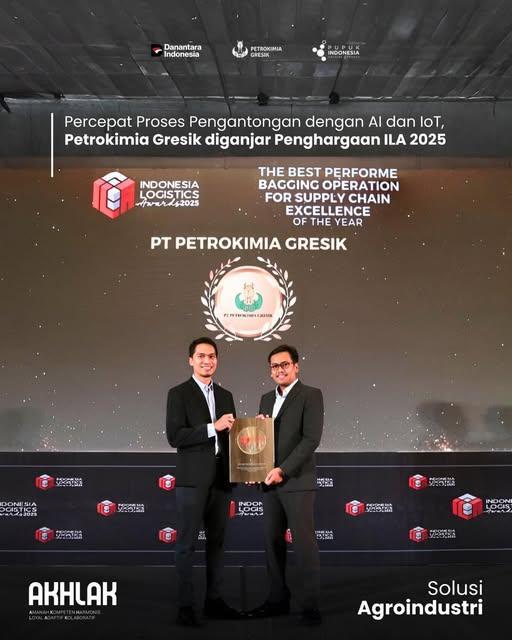
Since May 2025, the Company has operated an AI and Internet of Things (IoT)-based Smart Bagging Ecosystem for quality control in fertilizer bagging. This system automatically inspects the quality of bag stitching, validates production codes, and ensures the correct color of the fertilizer. Throughout 2025, the system reduced the volume of off-spec bagged products from 460.25 tons per month to 0 tons per month (i.e., eliminating the need for re-bagging). For this implementation, the Company received "The Best Performer – Bagging Operation" award at the 2025 Indonesia Logistics Awards.
Training on Ethical and Secure Use of AI
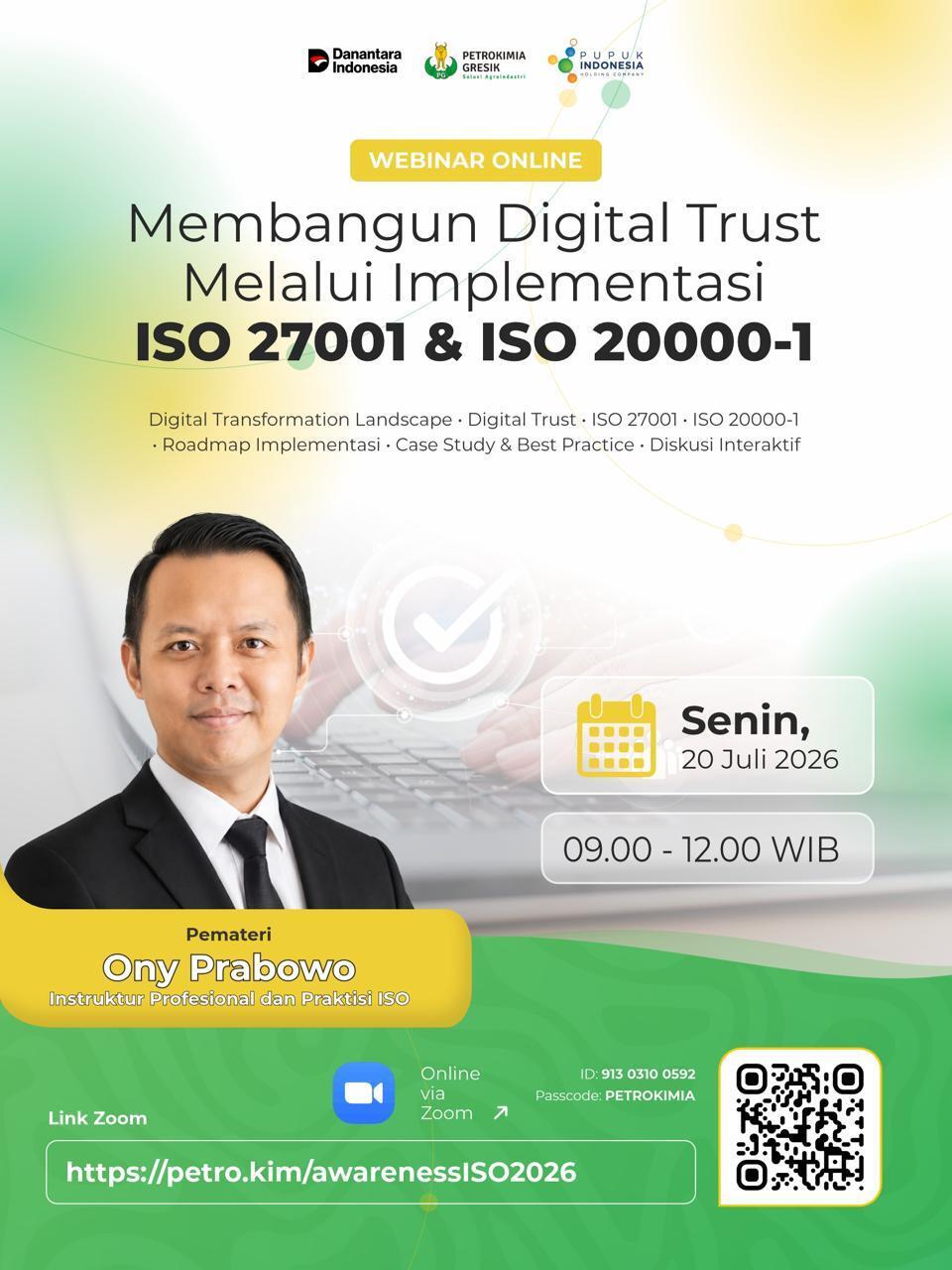
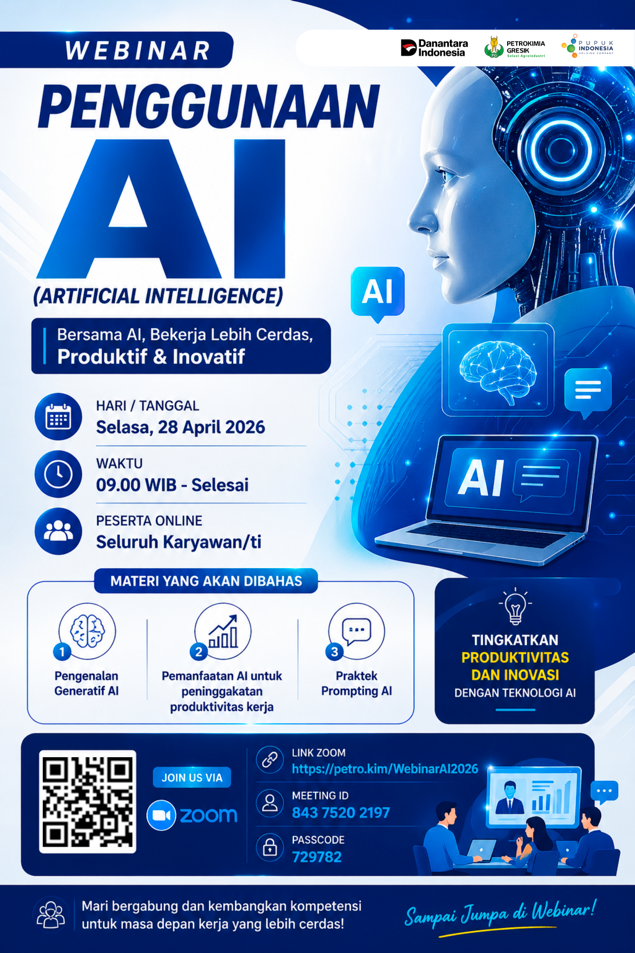
The company develops the digital capabilities of its employees through the "Digital Talent" program—targeting both "understanding" and "savvy" proficiency levels—while establishing technical competencies in Artificial Intelligence (AI) and Data Analytics for relevant functions. In 2026, the company hosted a webinar on the use of Artificial Intelligence (AI) on April 28, 2026, followed by a webinar on building digital trust through the implementation of ISO 27001 and ISO 20000-1 standards on July 20, 2026. A total of 358 employees participated in these training sessions, which covered topics such as specific AI modules—including the safe use of generative AI, the prohibition against inputting confidential data into public AI tools, and the protection of personal data in accordance with Law No. 27 of 2022. Furthermore, participants gained an understanding of information technology management systems—encompassing IT service management and information security—as well as the knowledge and skills required to implement ISO/IEC 20000-1:2018 and ISO/IEC 27001:2022 at PT Petrokimia Gresik. This program complements the broader information security awareness initiatives—based on the ISO/IEC 27001:2022 standard—that were provided to all employees.
1. PURPOSE & SCOPE
Policy Purpose
PT. Petrokimia Gresik (Persero) is committed to adopting, developing, and deploying Artificial Intelligence (AI) technologies in a responsible, ethical, secure, and sustainable manner. This Policy establishes a binding formal governance framework for utilizing AI across plant operational excellence, manufacturing asset reliability, fertilizer supply chain and distribution optimization, chemical process and occupational safety (HSE/Process Safety), and industrial customer/partner services, while firmly upholding regulatory compliance, data ethics, and environmental stewardship.
Scope of Application
This Policy applies to all operating subsidiaries, chemical/fertilizer manufacturing facilities, supply chain and logistics divisions, corporate functions, employees, technology vendors, and third-party contractors. It encompasses all algorithms, machine learning models, and automated systems whether developed in-house or procured from external vendors across the entire AI lifecycle (model architecture, industrial process data training, validation, operational deployment, and continuous monitoring).
2. PRINCIPLES OF GOVERNANCE
1. Respecting Data Privacy across AI Lifecycle
The Company designs and operates AI systems in full compliance with applicable personal data protection laws and international standards. We safeguard the personal data of our workforce, industrial clients, distributors, retail partners, and farming communities, as well as confidential operational and proprietary chemical formulations, through strict data minimization, robust encryption, and legitimate consent frameworks.
2. AI Cybersecurity & OT/IT System Protection
Given the integration of AI models with industrial control and Operational Technology (OT) networks (such as SCADA/DCS), the Company enforces rigorous cybersecurity controls. This includes industrial network segregation, secure coding audits, robust encryption at rest and in transit, routine penetration tests, and prompt shields designed to prevent malicious instruction injections and disruptions to critical plant operations.
3. Avoiding Algorithmic Bias & Ensuring Fairness
The Company is committed to ensuring objectivity and algorithmic fairness. Training datasets used in models for fertilizer supply allocation, vendor qualification, distributor scoring, or human resource evaluation must be balanced and non-discriminatory. Routine bias audits and performance drift assessments are conducted to rectify deviations and secure equitable outcomes across all stakeholders.
4. Human-in-the-Loop (HITL) for High-Stakes Industrial Decisions
The Company enforces a mandatory Human-in-the-Loop (HITL) framework, prohibiting autonomous AI systems from executing high-stakes decisions without qualified human supervision—especially concerning chemical process safety, emergency shutdowns, environmental containment, and major commercial transactions. Certified plant and operational personnel retain absolute authority to supervise (human-on-the-loop), approve (human-in-the-loop), and override (human-in-command) automated recommendations.
5. Ensuring Transparency & Algorithmic Explainability
The Company upholds transparency by explicitly labeling AI-powered operational interfaces, supply chain recommendations, and digital agronomy advisory tools. Industrial AI architectures must provide clear explainability, allowing plant engineers, compliance auditors, and commercial partners to understand the technical rationale and input factors underpinning AI decisions and forecasts.
6. Clear Governance Accountability & Review Mechanisms
The Company designates formal governance roles responsible for AI operational integrity, risk management, and regulatory compliance. Furthermore, structured, accessible grievance and review mechanisms are established, allowing distributors, industrial clients, and impacted partners to contest or request manual human reassessment of decisions influenced by AI models.
7. Defining Clear Operational Boundaries & Safety Guardrails
The Company defines strict authorized use cases, role-based access controls, and technical boundaries for AI deployments—including facility computer vision monitoring and plant analytics. Systems are confined to designated operational envelopes with robust technical guardrails to prevent unapproved expansion (mission creep) or unauthorized access outside safe operational parameters.
8. Minimizing Ecological & Carbon Footprint of AI Systems
Aligned with the decarbonization roadmap, the Company actively minimizes the environmental footprint of AI computational infrastructure. We enforce energy efficiency benchmarks, monitor power and cooling-water usage across on-premise data centers (employing advanced cooling containment), and require third-party cloud computing partners to demonstrate certified renewable energy usage and verified carbon-reduction roadmaps.
9. Absolute Prohibition of High-Risk & Unethical AI Systems
The Company strictly prohibits the acquisition, deployment, or operation of unacceptable-risk AI systems (in alignment with the EU AI Act framework), including:
(a) subliminal or deceptive manipulative systems that distort human behavior;
(b) systems exploiting vulnerabilities related to socioeconomic status, age, or disability;
(c) social scoring classifications; and
(d) unauthorized, real-time remote biometric surveillance in non-regulated environments.
3. APPROVAL OF CORPORATE GOVERNANCE
Highest Decision-Making Endorsement
This Responsible Artificial Intelligence Policy has been formally reviewed, approved, and endorsed by
the Board of Directors / Executive Management of
PT. Petrokimia Gresik (Persero).
This Policy is effective immediately upon approval and constitutes mandatory compliance across all manufacturing, supply chain, commercial, and administrative units. Periodic governance review and updates shall be conducted at least annually to maintain continuous alignment with industrial tech innovations and evolving regulatory frameworks.